If rising home values already grow tax collections, why does Prop 1 ask for more than double?
Seattle's 2019 library levy expires this year. Its replacement, Proposition 1, asks voters for $479.76 million over seven years — more than double the $219.1 million raised last time. The honest answer starts with a state law most voters have never heard of.
It's not that assessed values aren't rising — it's that Washington law generally caps how much more revenue a regular levy can collect year over year, around 1%, regardless of how much home values increase citywide (new construction is added on top as an exception). Raising a levy beyond that requires going back to voters, which is what Prop 1 does: it authorizes a new, higher base rate rather than just tracking value growth.
0
Avg. annual cost under Prop 1 (up from $84 under the 2019 levy)
0
Total raised over 7 years if Prop 1 passes
0
Share of total city property tax bill libraries would represent
0
Resulting max city levy rate per $1,000 assessed value (statutory cap: $3.60)
Size of Seattle's library ballot measures over time
Source: Seattle City Council, "2026 Library Levy Renewal" · King County Elections ballot measure text. 1998 measure was a capital bond, not an operating levy — different mechanism, shown for scale.
The dollar figure has more than doubled roughly every 7-14 years since 1998 — but so has the library system it funds: 27 branches, rising e-book costs, and a Central Library due for major upkeep.
Levy funds ~1/3 of the library system's operating budget across 27 branches — without it, the Chief Librarian says the system faces "hard decisions."
71% of new money just keeps current programs (no late fines, open hours) running at pace with inflation and e-book cost spikes, not new spending.
Property tax burden is relative: if a homeowner's assessed value rises slower than the citywide average, their bill can rise less than the headline rate — or even fall.
Seniors, veterans, and people with disabilities can qualify for exemptions under state law.
— Yes Seattle Libraries campaign; PubliCola, July 2026
Reasons for caution
The measure pushes the city's total regular property tax rate to $3.14/$1,000 — close to the $3.60 statutory ceiling, leaving less room for future levies.
Councilmember Maritza Rivera warned the city "didn't leave very much for the subsequent future levy renewals" — including the housing levy, which expires in 2030.
The dollar total more than doubles the prior levy, a headline number that's easy to react to before the inflation-adjustment context is explained.
Property taxes stack on top of Seattle's already-high combined sales tax and payroll tax burden on residents and employers alike.
— KNKX Public Radio, July 2026; Seattle City Council hearing record
Transit
Should Link Light Rail go elevated through Rainier Valley?
It isn't on any ballot — but it's the single most persistent transit-safety debate in the city.
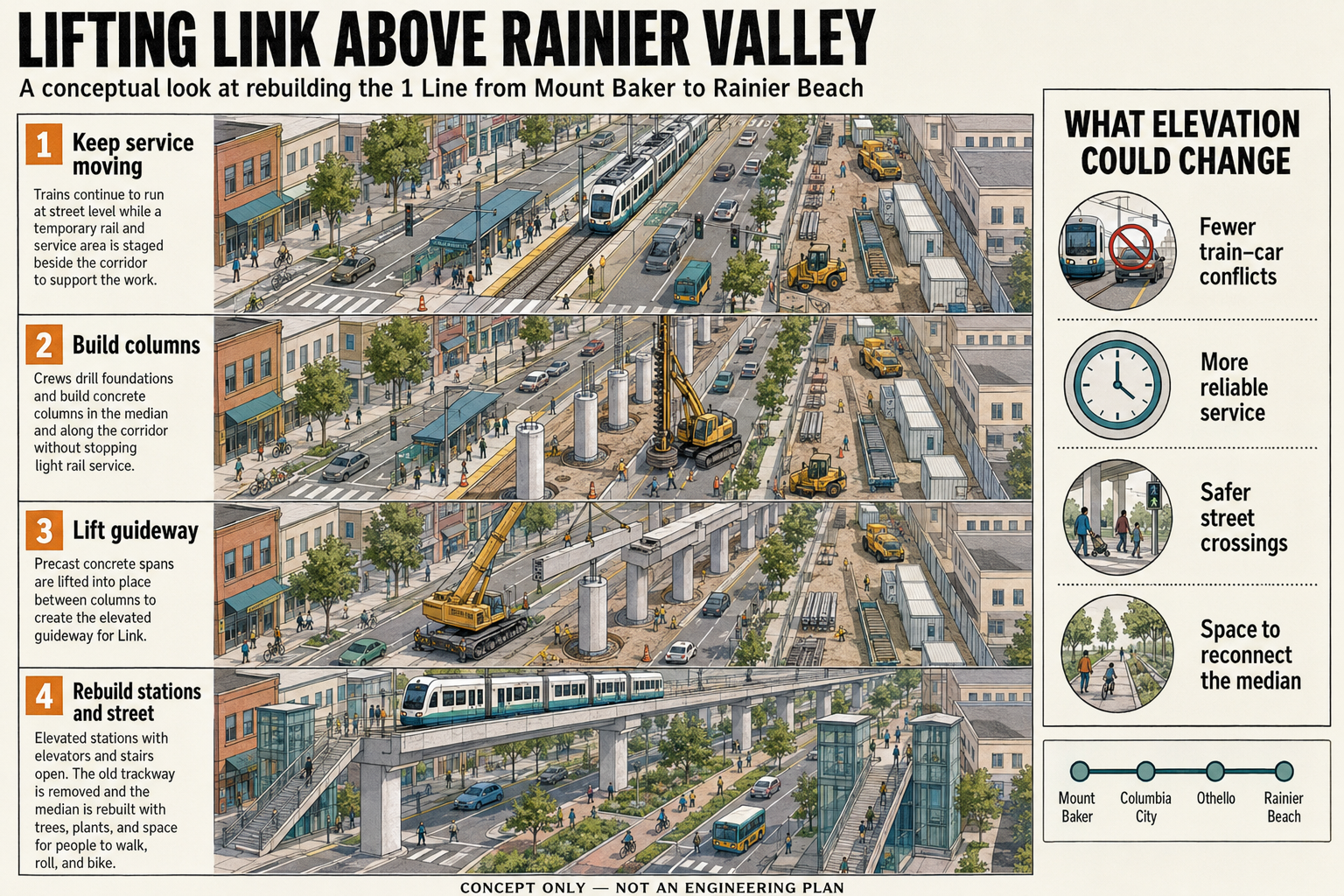
Between Mount Baker and Rainier Beach stations, Link Light Rail runs at street level down the middle of Martin Luther King Jr. Way S — the only long at-grade stretch left on the line. Trains share the road with cars, bikes, and pedestrians at dozens of intersections, and it shows: since service began in 2009, trains have collided with vehicles roughly every 40-45 days on average.
Concept illustration, not an official Sound Transit engineering plan — for orientation only.
~45
Days between average vehicle-train collisions pre-pandemic on this corridor
0
Cheapest of 3 grade-separation options studied — an open trench (2023 dollars)
3
Grade-separated options Sound Transit studied in 2023: elevated guideway, tunnel, open trench
2009
Year at-grade service began — the alignment dates to a cost-driven 1996 vote
How we got here: the Rainier Valley corridor (hover a marker for details)
Sources: Wikipedia (Rainier Beach station, sourced to Sound Transit records); The Urbanist, 2022-2024; Seattle Transit Blog, June 2026
The case for elevating
Removes the corridor's most dangerous design flaw — trains sharing a grade with cars and pedestrians at dozens of crossings.
Advocates propose converting the freed at-grade tracks to a frequent local streetcar, adding infill stations while speeding up the regional line.
Reclaimed street level could add protected bike lanes, wider sidewalks, and green space along the corridor itself.
Grade separation is standard practice elsewhere in the Link Light Rail system going forward — Sound Transit says new crossings won't be built at-grade.
— The Urbanist, "The Case for Improved Light Rail in Rainier Valley," 2022
The case for caution
Even the cheapest studied option, an open trench, runs an estimated $1.1 billion — with no funding identified.
Sound Transit's near-term response has focused on cheaper fixes: pedestrian gates, brighter lighting, louder warning chimes ($14-21M planned).
Given the agency's current financial position, a full grade-separation project is realistically decades away.
Years of construction disruption through an active business and residential corridor is a real cost, not just a budget line.
— Seattle Transit Blog, June 2026; The Urbanist, Dec. 2024
Streets
How do you actually get bike lanes on Lake Washington Boulevard?
Also not on a ballot. Just the closest thing Seattle has to a permanent pilot program.
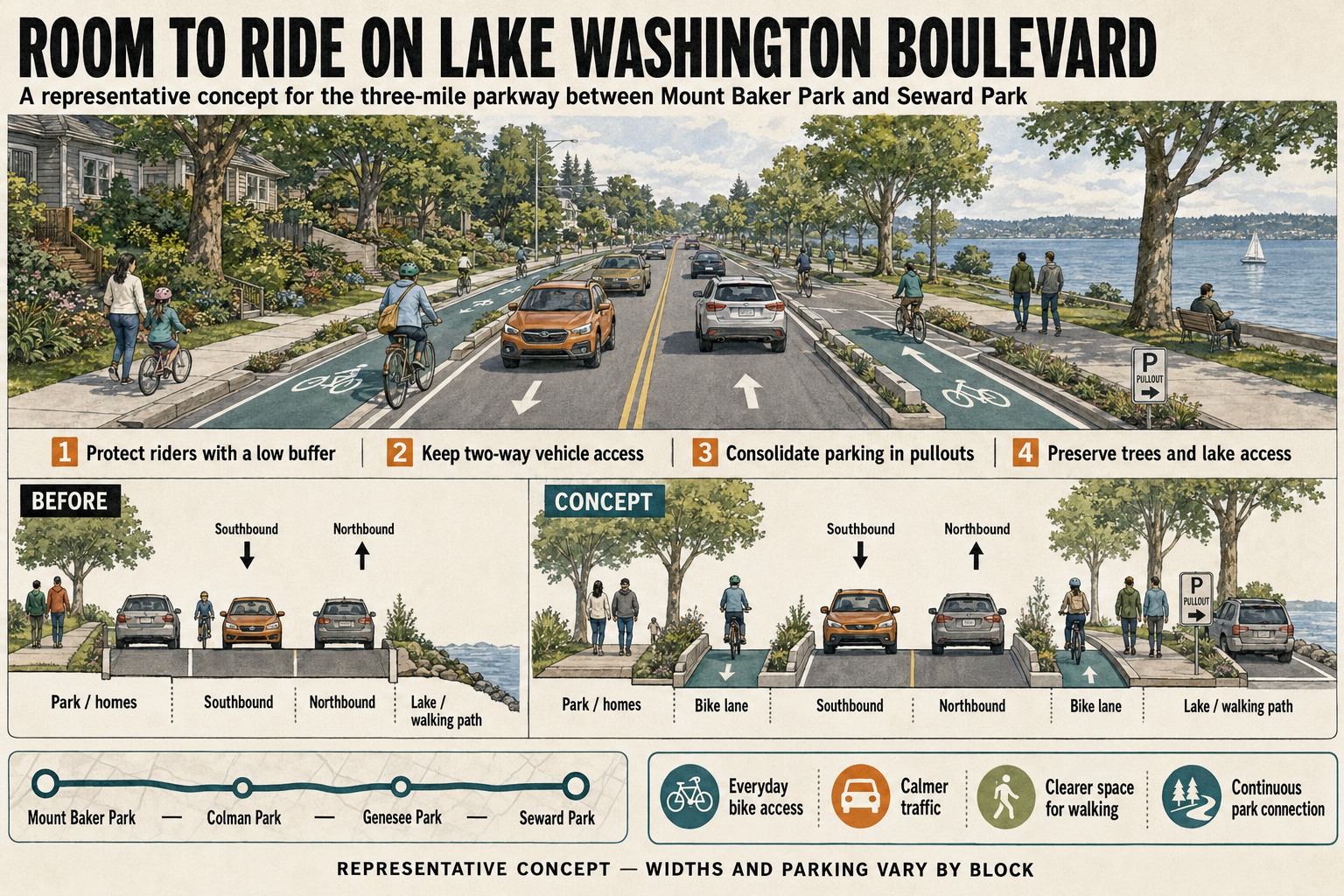
Lake Washington Boulevard has been Seattle's most contested "temporary" street since 2020, when a pandemic-era closure between Seward Park and Mount Baker opened it to walking, rolling, and biking. Six years, one task force, one visioning report, and one round of "fog line" traffic paint later, it still doesn't have a dedicated, permanent bike lane.
Representative concept, not an adopted SDOT/Parks design — widths and parking vary by block.
Six years of "temporary" (hover a marker for details)
Sources: SDOT project pages, 2020-2023; Seattle Parks & Recreation flyer, 2023; Seattle Bike Blog, July 2025; The Urbanist & Capitol Hill Seattle, April 2026
0
Seattle Park District funding for the current renovation phase — explicitly excludes a dedicated bike lane
2020
Year the first pandemic-era "Stay Healthy Street" pilot closed the boulevard to cars
2026
Bicycle Weekends expanded to every weekend, Memorial Day-Labor Day, under Mayor Katie Wilson
The case for a permanent lane
Seattle Neighborhood Greenways and Disability Rights Washington argue painted "fog lines" without traffic calming don't create real separation or safety.
The boulevard has been one of the city's most-used cycling routes for its entire history, connecting Seward Park to the Mount Baker light rail station.
The 2024 Transportation Levy already funds "People Streets and Public Spaces" and low-pollution-neighborhood work the city could extend here.
A permanent design would end the cycle of pilot-then-rollback that's repeated since 2020.
— Lake Washington Blvd Task Force records; Seattle Bike Blog, July 2025
The case for caution
Coexist Lake Washington, a driver-access group on the task force, has pushed to preserve through-traffic and parking access along the corridor.
Mayor Harrell's administration scaled back planned traffic-calming elements in 2025, leaving only cosmetic "fog line" changes — a sign of how contested the tradeoffs remain.
The current renovation budget ($404K) is scoped for ADA sidewalk and crossing work, not a full bike lane redesign — that would need new funding.
Neighboring residents have raised concerns about traffic diversion onto side streets during closures.
— Coexist Lake Washington, via SDOT task force materials; Seattle Bike Blog, July 2025
The Tax Stack
Part sales tax. Part property tax. Part everything else. Here's what it adds up to.
No single bill shows you the whole picture. Put every source together, and this is roughly how Seattle's general-purpose tax base actually breaks down.
Where the money in Seattle's general fund actually comes from
Source: Seattle City Council Budget Review, "General Fund Revenue by Source." Property tax's share has stayed close to this mix — the city's 2026 budget documents cite it at roughly 24% of General Fund revenue. Voter-approved levies (library, parks, housing, transportation, democracy vouchers) sit outside the general fund and are shown separately below.
Property tax and sales tax are close to even — but B&O and utility taxes, the two categories nobody talks about at dinner, are almost as large as either one.
Every tax, by which pocket it comes from
Tax / Levy
Type
Rate or amount
Example cost
Status
Sales taxes
General sales tax
Sales
10.55% combined
$52.75 on a $500 purchase
Ongoing
↳ includes Sound Transit's ST3 share
Sales
1.4% of the 10.55%
not an extra charge
Through ~2046
Consumption taxes
Sweetened beverage tax
Excise
$0.0175/oz
$0.21 on a 12oz can
Ongoing
Gasoline tax (state + federal)
Excise
$0.565 + $0.184/gal
~$0.75/gal combined
State rate rises 2%/yr
Property taxes
Base property tax (all districts)
Property
~$9.19/$1,000 AV
~$7,944/yr on $864K home
Ongoing
Seattle Public Library Levy
Property
$0.23/$1,000 AV (proposed)
~$193/yr avg home
On Aug 4, 2026 ballot
Seattle Park District
Property
~$0.37-0.41/$1,000 AV
~$297-356/yr median home
Permanent district, est. 2014
Seattle Housing Levy
Property
$0.45/$1,000 AV
~$383/yr avg home
2024-2030
Seattle Transportation Levy
Property
~$0.65/$1,000 AV
~$499-528/yr median home
2025-2032
Democracy Voucher Program
Property
$0.0142/$1,000 AV
~$13/yr avg home
2026-2035
Sound Transit property tax (ST3)
Property
$0.16/$1,000 AV
~$138/yr on $864K home
Through ~2046
Other taxes (business-side, passed through, or easy to miss)
JumpStart payroll tax
Business
0.746%-2.557% of payroll
$1,450-$9,390/job in 2026
Through 2040
B&O tax
Business
0.222%-0.658% of gross receipts
~19% of general fund
Ongoing
Sound Transit MVET (car tabs)
Vehicle
1.1% of vehicle value
$80-$110/yr per $10K vehicle
0.3% expires 2028
Seattle Telephone Utility Tax
Utility
6% of gross receipts
passed through on your bill
Ongoing
E-911 Emergency Surcharge
Utility
$0.25 state + $0.50 county/line
$0.75/month per phone line
Ongoing
Sources: WA Dept. of Revenue; Seattle City Finance (SMC 5.48, Dir. Rule 5-300); King County Assessor 2026 Levy Report; WUTC E-911 tax schedule; Seattle City Council; SPL; SEEC; Sound Transit.
For reference — how Seattle's sales tax compares to other big cities
Combined sales tax rate, selected cities
Source: Washington State Dept. of Revenue, Local Sales & Use Tax Rates, Q2 2026 (location code 1726) · calculory.com city comparison, April 2026
Your home, itemized
Seattle does levy its own city property tax — it's one of many taxing districts layered onto your bill, alongside the state, county, schools, and every voter-approved district. King County just bills and collects all of them together as one consolidated statement, rather than mailing a separate bill from each authority. For a home assessed at $864,000, the 2025 combined rate across every one of those districts was $9.19418 per $1,000 — a total bill of $7,943.77. Most regular levies can grow by roughly 1% a year without a new vote (new construction is an exception, added on top); nearly all of the recent increases beyond that come from voters approving new or renewed levies, not rising home values alone.
What Seattle's voter-approved levies cost one $860K-ish home, per year
Each levy uses its own program's published example (assessed values range $804K-$1M across sources; figures are illustrative, not additive to a single exact bill). Sources: SPL, Seattle Park District, Seattle Office of Housing, SDOT, SEEC.
Every major levy: when it runs, and what it costs your household
Annual cost to an average Seattle household, by levy (hover a bar for exact dates)
Shown as each program's own published average household cost, not the total dollars collected — that view is in the chart above. The 2012 Library Levy is omitted; no average household cost was published for it. Sound Transit's ST3 property tax and the Seattle Park District have no fixed end date (ST3 revenue continues through roughly 2046; the Park District is a permanent taxing district). Sources: Seattle City Council; SPL; Seattle Office of Housing; SDOT; SEEC; Sound Transit.
Democracy Vouchers: the smallest line item, first-in-the-nation
Since 2017, every eligible Seattle resident gets vouchers to donate to city candidates who agree to spending limits — first-of-its-kind in the U.S. Voters renewed the funding levy in August 2025, raising it from $3M to $4.5M a year through 2035.
What the Democracy Voucher levy costs an average home, per year
Source: King County Elections voter pamphlet (2015 measure); Cascade PBS, July 2025 (2025 renewal)
Business taxes: the ones that never touch your receipt
JumpStart tax rate, by tier
Source: Seattle City Finance, Payroll Expense Tax rate tables, 2026
Where 2026 JumpStart revenue goes
Source: City of Seattle 2026 Adopted Budget, Multi-Department Revenue Summary
Nearly half of JumpStart revenue — originally earmarked for housing and equitable development — is now propping up Seattle's general fund.
What the sugar tax actually adds to what you buy
Sweetened beverage tax, added cost by container size
Source: City of Seattle Sweetened Beverage Tax rate ($0.0175/oz), applied to common container sizes. Tax is legally on distributors, but studies found it passes through to shelf prices almost dollar-for-dollar.
Sound Transit's separate 2026 property tax rate, per $1,000 of assessed value (about 0.016% — not comparable in scale to the sales/vehicle rates above, since it applies to home value, not spending)
Property tax rate can rise up to 1%/yr without a new vote, per the original 2016 ballot measure, up to a $0.25/$1,000 statutory ceiling. Source: Sound Transit, Oct. 2025 presentation to its Board.
Elected Officials
Who's actually deciding all of this
Every levy, ballot measure, and public-space fight above ultimately gets a vote from these people.
Name
Role
Term start
Term end
Katie Wilson
Mayor
Jan 2026
Dec 2029
Joy Hollingsworth
Council President & District 3
Jan 2026 (President) / Jan 2024 (D3)
Jan 2028 (President) / Dec 2027 (D3)
Rob Saka
District 1
Jan 2024
Dec 2027
Eddie Lin
District 2
Dec 2025
Dec 2027
Maritza Rivera
District 4
Jan 2024
Dec 2027
Debora Juarez
District 5 (appointed)
Jul 2025
Pending Nov 3, 2026 special election
Dan Strauss
District 6
Jan 2024
Dec 2027
Robert Kettle
District 7
Jan 2024
Dec 2027
Alexis Mercedes Rinck
Position 8 (citywide)
Jan 2026
Dec 2029
Dionne Foster
Position 9 (citywide)
Jan 2026
Dec 2029
Sources: Seattle City Council; Ballotpedia (2025 & 2026 Seattle elections); Wikipedia officeholder infoboxes, cross-checked against KUOW, The Urbanist, Cascade PBS, and KING 5 reporting, Jan-Apr 2026. District 5 is currently held on an appointed/interim basis pending the Nov 3, 2026 special election to fill the remainder of the term through Dec 2027.